Should You Include Your GPA on Your Resume? What 633 Intern and New-Grad Postings Show

Short answer
Include your GPA if you are a student or recent graduate and it is 3.0 or higher, or if the posting asks for it. Leave it off if it is below 3.0 or once you have full-time experience in your field. In 633 intern and new-grad postings we checked, 31% asked for GPA, mostly in a required application-form field.
Key takeaways
- 196 of 633 early-career postings (31%) at 14 of 39 employers asked for a GPA. Without the two biggest askers, SpaceX and Rocket Lab, the share was 16% (84 of 511).
- Most asked in the application form: 192 postings had a GPA question there, 91 mentioned GPA in the job description, and 105 asked only in the form. Six employers asked only in the form.
- At 12 of the 13 employers whose forms asked, the GPA field was required. Leaving GPA off your resume does not keep it from those employers, so the number you give must match your transcript.
- Every GPA number named in a posting, as a minimum or a preference, was 3.0 or higher, and 3.5 appeared at 5 of the 7 employers that named one.
- Outside early-career roles, GPA almost disappears from the job description: 16 of 17,436 other postings (0.09%) mentioned it, all for junior or entry-level roles such as coordinators, junior traders and researchers.
We collected 18,154 job postings from 68 employers on November 14, 2026, including the application-form questions for every internship and new-grad posting on Greenhouse, and counted where and how they ask for a GPA. Most advice on this question gives one rule, usually "include it if it's 3.5 or higher," without saying where the number comes from. The postings show something that advice leaves out: many employers that care about GPA never mention it in the job description. They ask for it in the application form, often as a required field. That changes the question from "should I reveal my GPA?" to "should I put it on the page a recruiter reads first?" This guide gives a decision rule by GPA and career stage, then the job-posting data behind it, how to format the line, when to take it off, and what to do with a low GPA.
When to put your GPA on your resume: a decision rule
Two things decide it: how strong the number is and how far you are into your career. The posting can override both. If it names a minimum GPA or asks for one, follow it. The 3.0 line in the table is not arbitrary. It was the typical minimum when employers screened by GPA in 2019, according to the National Association of Colleges and Employers (NACE), and it is the lowest GPA number any posting in our sample named, as a minimum or a preference. That is why this rule sets the line at 3.0 rather than the 3.5 many guides use: a GPA between 3.0 and 3.5 meets the common floor, so for internships and new-grad roles it is usually worth showing. 3.5 is the bar for the most selective programs, covered below.
| Your situation | GPA on the resume? | Why |
|---|---|---|
| Student or recent graduate, GPA 3.5 or higher | Yes | It clears every GPA number named in the postings we checked. |
| Student or recent graduate, GPA 3.0 to 3.49 | Yes, for internships and new-grad roles | It meets 3.0, the typical minimum in NACE's data and the lowest number any posting in our sample named. |
| Student or recent graduate, GPA below 3.0 | No (consider your major GPA) | Every GPA number named in our sample's postings was 3.0 or higher. Lead with projects, work and coursework instead. |
| The posting names a minimum GPA or asks for it | Yes, if you meet it | The employer has told you it screens on GPA. |
| Applying to trading, banking or other finance roles | Yes | Duke's economics department tells students to include cumulative GPA for finance firms; 6 of the 10 trading and investment firms with early-career postings in our sample asked for it. |
| Full-time job in your field, or about three years since graduation | No | Only 16 of 17,436 non-early-career postings mentioned GPA in the job description. |
What 633 internship and new-grad postings ask about GPA
We pulled every open posting from the public job boards of 68 employers that use Greenhouse or Lever, two hiring systems many companies run their careers pages on. The employers are mostly tech, fintech and trading firms, plus some aerospace, health, media and consumer companies. We flagged early-career postings by title (intern, co-op, new grad, early career, apprentice and similar) and, for Greenhouse postings, downloaded the application form's questions as well. The result is lopsided. GPA is a common question in early-career hiring and almost absent everywhere else. How we got this. On November 14, 2026 we downloaded every open posting from the public Greenhouse and Lever job boards of 99 employers chosen in advance; 68 had an active board, giving 18,154 postings. For the 633 early-career Greenhouse postings we also downloaded the application form's questions. A posting counts as asking if its text or a form question mentions GPA or grade point average. Limits. This is a convenience sample of large employers, weighted toward tech and trading firms, from one day. Early-career roles are identified by job title, so a few entry-level roles with titles like "Junior Trader" fall in the "other" group. Form questions are only available for Greenhouse. SpaceX and Rocket Lab account for 112 of the 196 postings that asked. The figures describe these postings, not the whole US job market.
| Postings | Number | GPA in the job description | GPA question in the application form | Either |
|---|---|---|---|---|
| Early-career postings (14 of 39 employers asked) | 633 | 91 (14%) | 192 (30%) | 196 (31%) |
| Early-career, without SpaceX and Rocket Lab | 511 | 12 (2%) | 80 (16%) | 84 (16%) |
| All other postings (all 68 employers, both job boards) | 17,436 | 16 (0.09%) | not collected | n/a |
Employers often ask for GPA in the form, not the job description
The table below lists the 14 employers whose early-career postings asked. Six of them (Stripe, IMC, Databricks, Verkada, Roblox and Hudson River Trading) never mentioned GPA in any posting text. You would only find out when you reached the application form. The forms are specific. Rocket Lab and SpaceX ask you to pick your GPA to one decimal (3.4, 3.3, 3.2…), separately for undergraduate and graduate study, with "Below 3.0" as the lowest choice on a 4.0 scale. IMC's lowest option is "Below 3.2"; in Verkada's multiple-choice version it is "3.0 or under." One Point72 form asks for the scale your school uses. Only Stripe made the question optional. Some required fields offer a way out, such as SpaceX's "Not applicable/Do not recall" and Virtu's "I'd rather not disclose." What this means for your resume. At employers with a required GPA field, the employer gets your GPA whether or not it is on the resume. The resume decision is about first impressions for everyone else: readers who may see only your resume, such as referrals and career fairs. And because the form asks for your real GPA, either as a number or as a range to pick from, the figure on your resume must be consistent with what you enter.
| Employer | Type | Early-career postings that asked | GPA in the job description | Form question required? |
|---|---|---|---|---|
| Rocket Lab | Aerospace | 63 of 65 | Yes: 3.0 minimum, 3.5 "nice to have" | Yes |
| SpaceX | Aerospace | 49 of 57 | Some: 3.5 (mostly preferred) | Yes |
| Stripe | Tech | 24 of 36 | No | No (optional) |
| IMC | Trading | 9 of 19 | No | Yes |
| Virtu | Trading | 9 of 13 | Some: "a strong GPA" | Yes |
| Point72 | Investment | 8 of 22 | Some: 3.2 or 3.4 minimum | Yes |
| Databricks | Tech | 7 of 23 | No | Yes |
| Verkada | Tech | 7 of 9 | No | Yes |
| Duolingo | Tech | 5 of 5 | One posting: 3.5+ | Yes |
| Roblox | Tech | 5 of 7 | No | Yes |
| Hudson River Trading | Trading | 5 of 5 | No | Yes |
| Akuna Capital | Trading | 3 of 3 | Yes: 3.5 | Yes |
| DRW | Trading | 1 of 10 | Yes: 3.5 minimum | Yes |
| Oscar Health | Health insurance | 1 of 1 | Yes: 3.0 or higher for current students | No form question |
What GPA cutoffs do employers name?
Seven employers in our sample wrote a GPA number into the posting, as a minimum or a preference, in 103 postings. None named less than 3.0. The lowest number in each posting was 3.0 in 72 of them (almost all Rocket Lab), 3.5 in 28, 3.2 in 2 and 3.4 in 1. Counted by employer rather than by posting, 3.5 appeared at 5 of the 7. The two numbers do different jobs. 3.0 is a floor: Rocket Lab's intern postings list it as a qualification, Oscar Health names it for current students applying to its actuarial internship, and SpaceX lists it for recruiting coordinators, mostly as a preferred qualification. 3.5 is the bar for the most selective programs: listed with the qualifications at Akuna Capital, a stated minimum at DRW, a preference in SpaceX's internship postings and Rocket Lab's "nice to have," and one of several signs of academic success in SpaceX's new-grad engineer postings. Screening by GPA is less common than it used to be, but it has not gone away. NACE reported that 73% of employers screened new graduates by GPA in 2019, typically with a 3.0 minimum (NACE). That share fell to a low of 37% in 2023, rose to 46% in the Job Outlook 2025 survey (NACE) and was 42% in the Job Outlook 2026 survey (NACE). In other words, a large minority of employers still filter on it, and our data shows which kinds of employers ask for it: trading and investment firms (6 of the 10 with early-career postings in our sample asked), SpaceX and Rocket Lab, and some tech companies (5 of 15). None of the 6 fintech companies or the one media company with early-career postings asked.
How to list your GPA on a resume
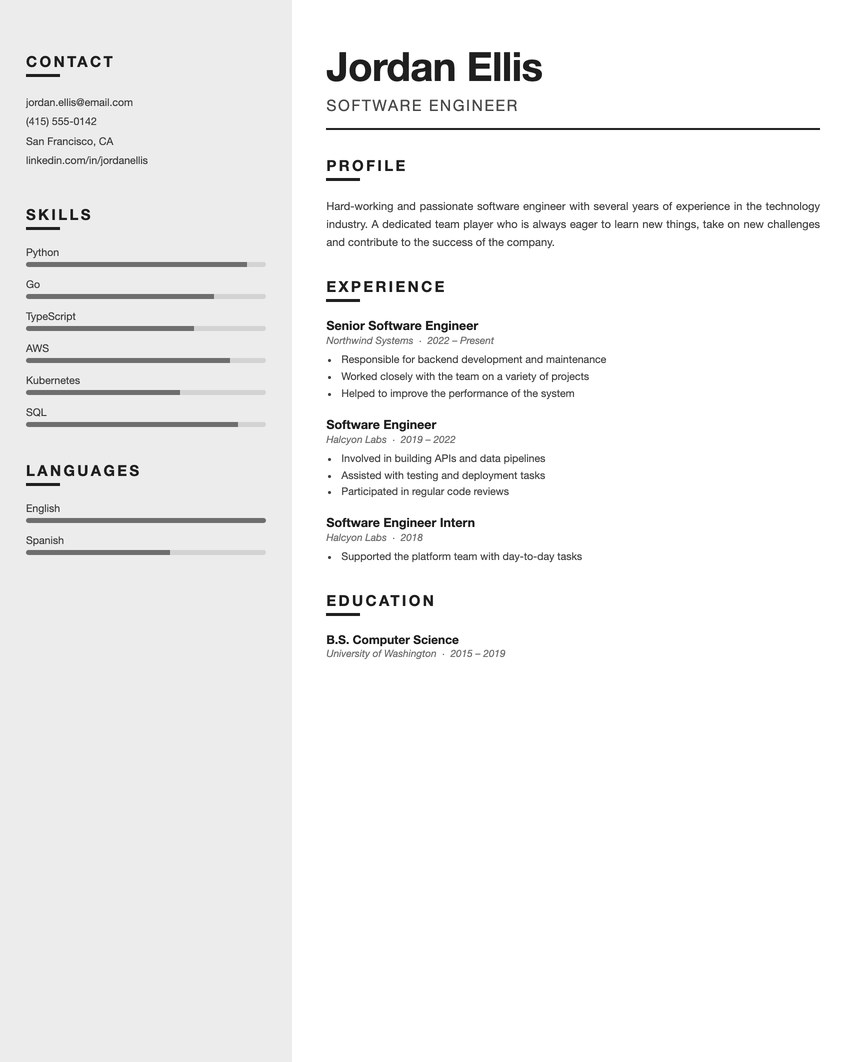
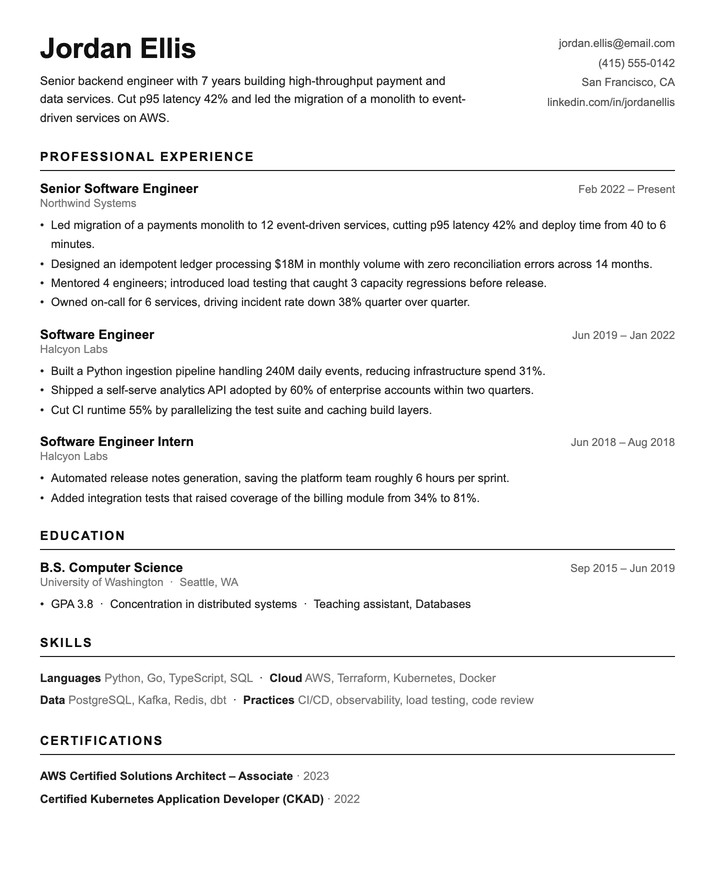
Put it in the Education section, on the same line as your degree or the line under it. Write it to two decimal places, rounded normally, with the scale: GPA: 3.62/4.0. Do not give it a section of its own, and do not put it in the summary. Do not round up past a threshold. Duke University's economics department allows standard rounding to one decimal place (3.42 becomes 3.4) but not rounding up beyond it: "rounding a 3.43 GPA to 3.5 is not acceptable and may be considered academic dishonesty" (Duke). We recommend two decimal places instead, so that a 3.47 is not read as meeting a 3.5 minimum. A resume number higher than your real GPA can also contradict what you enter in a required form field, where you pick your real GPA or the range it falls in. Major GPA. If your major GPA is clearly higher than your overall GPA and the job relates to your major, you can list it, labeled: Major GPA: 3.71/4.0. Never leave the label off, because an unlabeled number reads as your cumulative GPA. Forms ask for the cumulative figure, so be ready to give it. Latin honors and Dean's List. List them on the same line or the next one. Honors such as cum laude already say your GPA was high; you can show both, or let the honor stand alone if space is tight. Grades on another scale. If your school does not use a 4.0 scale, write the grade the way your transcript shows it and name the scale (for example "First-Class Honours" or "85/100"). The forms at Databricks, SpaceX and Rocket Lab tell applicants to convert their GPA to a 4.0 scale themselves (Rocket Lab's also lists 5.0-scale choices, and one Databricks form adds bands for Canadian percentage grades), while Hudson River Trading's form accepts UK degree classes. Use the conversion your school publishes if it has one. The example lines further down show these formats in full. For the rest of the page, see how long a resume should be and an ATS-friendly resume example.
When to take your GPA off your resume
Once you have a full-time job in your field, your results there say more than your grades, and your GPA line can go. Indeed and Coursera both put the cutoff at about three years after graduation (Indeed, Coursera). The postings agree. Of the 17,436 postings that were not internships or new-grad roles, only 16 mentioned GPA in the posting text, and every one of them was a junior or entry-level role: "Junior Trader" and "Junior Quantitative Researcher" at Akuna Capital, "Electrical Engineer I" at Rocket Lab, coordinator roles at SpaceX and a PhD quantitative researcher role at Virtu. In our sample, postings for experienced roles did not mention it in the posting text (we did not collect their application forms). The same applies to older material in general: our guide on how far back a resume should go covers what else to trim as your experience grows.
What to do if your GPA is low
If your GPA is below 3.0, leave it off the resume and give the space to evidence of what you can do: - Projects and results. A class project, a lab, a club role or a part-time job with a number attached (customers served, hours worked, a tool you built). - Relevant coursework, especially upper-level courses in which you did well. - Skills that match the posting. Our list of skills to put on a resume helps you choose. - A strong last two years. If your recent grades are much better than your overall GPA, a labeled "Last two years GPA" or major GPA can show the trend, as long as the label is clear. When an application form asks for your GPA, give the true number. A form question is not a reason to put the number on the resume too. Most of the multiple-choice forms we inspected had an option below 3.0 (IMC's lowest was "Below 3.2", and one Point72 form in percentages started at 80%), so you can usually answer truthfully and let the rest of the application carry the case. An internship cover letter is the place to point to experience that matters more than grades.
Your next step
Check your GPA against the rule above, write the line once in the exact format you will use everywhere, and read each posting and its application form before you apply. If the posting or the form asks for GPA, and yours meets the cutoff, the line belongs on your resume. If you want to check a resume against a specific posting, ATSOptimized compares your resume with the job description, shows which relevant terms are missing, and rewrites your existing experience to match, without adding anything you did not do.
Example phrases
Examples
- Standard: "B.S. in Mechanical Engineering, Lakeside University, May 2027 | GPA: 3.62/4.0"
- With honors: "B.A. in Economics, magna cum laude, Hillcrest College, May 2026 | GPA: 3.78/4.0 | Dean's List (6 semesters)"
- Major GPA only: "B.S. in Computer Science, Lakeside University, December 2026 | Major GPA: 3.54/4.0"
- Non-US scale: "BEng Electrical Engineering, Northgate University (UK), 2026 | First-Class Honours"
- Risky: "GPA: 3.5" (actual 3.47; reads as meeting a 3.5 minimum). Clear: "GPA: 3.47/4.0", or leave the line off.
Pro tips
- Write your GPA to two decimal places with the scale (GPA: 3.62/4.0), rounded normally from your transcript.
- Use two decimal places so a 3.47 is not read as meeting a 3.5 minimum. Application forms ask for your real GPA, as a number or a range, and the two should agree.
- Label a major GPA as "Major GPA"; an unlabeled number reads as your cumulative GPA.
- Read the application form before you finalize your resume: many employers ask for GPA there even when the posting does not mention it.
- Delete the GPA line when you start your first full-time job in your field.
Related terms
Frequently asked questions
Should I put my GPA on my resume if it's below 3.0?
Usually not. Every GPA number named in the postings we checked, as a minimum or a preference, was 3.0 or higher, so a lower number gives a screener a reason to stop reading. Leave it off, lead with projects, work and coursework, and give the true figure if an application form asks for it.
Is a 3.4 GPA good enough to put on a resume?
Yes, for internships and new-grad roles. A 3.4 clears 3.0, the typical minimum in NACE's employer data and the lowest number any posting in our sample named, though it falls short of the 3.5 bar some selective programs set. If the posting names 3.5, it is better to leave the line off than to round up.
When should I take my GPA off my resume?
When you have a full-time job in your field, or about three years after graduation at the latest. In our sample, only 16 of 17,436 postings that were not internships or new-grad roles mentioned GPA in the posting text.
What if the application asks for my GPA but it's not on my resume?
Answer the question with your exact GPA. In our sample, 192 early-career postings asked for GPA in the application form, and 12 of the 13 employers made the field required. Keeping it off the resume is fine, but the form answer must be accurate.
Should I list my major GPA or my overall GPA?
List your overall GPA by default. If your major GPA is clearly higher and the job relates to your major, you can list it instead or as well, always labeled "Major GPA." Expect forms to ask for the cumulative figure.
Can I round my GPA up on a resume?
Standard rounding is generally accepted: Duke University's economics department allows 3.42 written as 3.4, but says rounding 3.43 to 3.5 "may be considered academic dishonesty." We recommend two decimal places, so a 3.47 is not read as meeting a 3.5 minimum.