How to List Certifications on a Resume (What 17,982 Job Postings Show)

Short answer
List each certification on one line: the full name with its acronym, the issuing organization, and the month and year you earned it, plus the expiration date if it has one. Put them in a "Certifications" or "Licenses & Certifications" section, and if the job requires the credential, name it in your summary too. Write both the acronym and the full name: in the 17,982 US job postings we analyzed, 90% of certification mentions used only the acronym.
Key takeaways
- Use one line per certification: full name (acronym), issuing organization, month and year earned, and the expiration date if it has one. Example: "Project Management Professional (PMP), Project Management Institute, Mar 2025 – Expires Mar 2028".
- Write the acronym and the full name. We searched 17,982 US job postings collected on November 21, 2026 for 33 common credentials and found 1,224 mentions. 90% used only the acronym (CPA, PMP, CISSP) and 2% only the full name, so writing both covers either version.
- Most certification mentions in postings are a plus, not a must. In our sample, 71% of those mentions were in "preferred" or "nice to have" wording and 15% were stated as required. If you meet the rest of a posting, don't let a missing preferred certification stop you from applying.
- An in-progress certification can go on your resume if you label it. At least 63 postings from 27 employers in our sample accepted a credential that is in progress, "CPA eligible", or earned within a set time after hire. Write "In progress, exam scheduled Feb 2027", never just the name.
- Put a required license at the top too. If you can't do the job without it (a CPA license, a nursing license, a CDL), name it in your summary or after your name, not only in a section at the bottom.
Most guides to this question give the same format advice and stop there. We wanted to know how employers themselves write about certifications, so on November 21, 2026 we downloaded every open posting from 212 company job boards on Greenhouse and Lever, kept the 17,982 US postings (mostly from tech and finance employers), and coded every mention of 33 common certifications and licenses: how the posting spelled the credential, whether it was required or preferred, and whether an in-progress credential was accepted. Below you'll find the format to copy, where the section goes, what the job-posting data means for how you write each line, how to handle in-progress and expired certifications, and examples by field.
How to format a certification on your resume
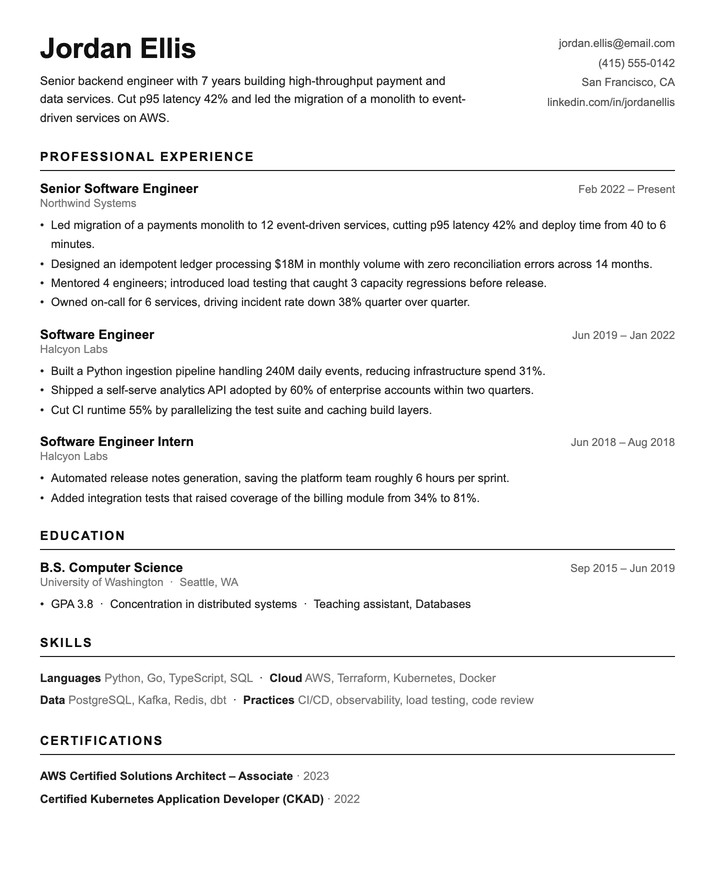
Each certification gets one line with the same elements in the same order. Use the format below, keep it consistent, and put the most relevant credential first. Certification Name (ACRONYM), Issuing Organization, Month Year earned – Expires Month Year - Certified Information Systems Security Professional (CISSP), ISC2, Jun 2024 – Expires Jun 2027 - CompTIA Security+, CompTIA, Jan 2025 – Expires Jan 2028 - Basic Life Support (BLS) Provider, American Heart Association, Aug 2025 – Expires Aug 2027 For a license, add the state, because licenses are issued by state boards and agencies, and mark it "active" or give its expiration date: "Certified Public Accountant (CPA), Texas, licensed 2022, active". A license number is optional; leave it off a resume you post publicly, and give it when an employer asks. Don't list a credential you don't hold or haven't renewed. Many are easy to check: NASBA's CPAverify lets anyone look up a CPA license by name in participating states, and American Heart Association eCards carry a QR code that employers can scan to verify the card.
| Element | Include? | Example |
|---|---|---|
| Full name of the certification | Always | Project Management Professional |
| Acronym | Always, if one exists | (PMP) |
| Issuing organization | Always | Project Management Institute |
| Month and year earned | Yes | Mar 2025 |
| Expiration date | If it expires | Expires Mar 2028 |
| State (licenses) | Yes, for licenses | Licensed in Texas |
| Credential ID or license number | Optional; give when asked | ID 1234567 |
| Status | Required if not finished | In progress, exam scheduled Feb 2027 |
Where to put certifications on a resume
Most resumes give certifications their own section with a plain heading: "Certifications", "Licenses & Certifications" or "Professional Certifications". A clear, standard heading is easy for a recruiter to find. Where that section goes depends on how much the job depends on the credential. The career advice republished by Harvard's career services office suggests putting the section below your work experience in general, moving it toward the top if you're entry-level, and adding a credential you can't do the job without right after your name, as in "Priya Anand, RN" or "Timothy Oluwa, CPA". If you have only one certification and no room for another section, you can add it to your Education section and rename it "Education & Certifications". Don't hide a certification inside a skills list; a skills line has no room for the issuer or the date.
| Your situation | Where it goes |
|---|---|
| The job requires a license or certification you hold | After your name and in your [summary](/career-advice/resume-summary-examples), plus the full line in the Certifications section |
| Certifications are your strongest qualification (entry-level, career change) | Certifications section near the top, above Experience |
| Experienced, certifications are a plus | Certifications section after Experience |
| One certification, short resume | Education & Certifications section |
| Many certifications | Only the ones relevant to this job, most relevant first |
Acronym or full name? What 17,982 job postings show
Job postings almost always use the acronym alone. We searched for 33 common certifications and licenses and found 1,224 mentions: 1,102 (90%) gave only the acronym, 93 (8%) gave both, and 29 (2%) gave only the full name. Counting each employer once per credential, 395 of 425 employer-credential pairs (93%) mostly used the acronym only. A typical line, from a Dropbox posting: "Security certifications such as CISSP, CCSP, or equivalent." No full names. CDL was the clearest exception among the most-mentioned credentials: 24 of the 47 postings that named one (from 8 employers) included the full name "Commercial Driver's License". What this means for your resume: write the full name once with the acronym in parentheses, as in "Certified Information Systems Auditor (CISA)". The acronym matches the way postings are written, the full name helps a reader who doesn't know the acronym, and a text search for either form finds your line. We don't know how any particular applicant tracking system or recruiter search handles acronyms, and you don't need to: with both forms on the page, either version is there. If a posting uses a specific variant ("CompTIA Security+", "SHRM-CP"), use that exact spelling. How we got this. On November 21, 2026 a script downloaded all open postings from 212 employer job boards on Greenhouse and Lever (public job-board APIs, no login): 30,322 postings. We kept postings with a US location, dropped one aggregator board and exact duplicates, which left 17,982 US postings from 191 employers. We searched them for 33 credentials by acronym and by full name. Acronyms that mean other things in job ads (for example CPA as "cost per acquisition" in marketing postings, CMA, PE, RN) were excluded or filtered, and we checked a random sample of 50 coded mentions by hand. A later recheck of the CPA rows found 14 that aren't requests for the credential (such as "lowering CPAs" in an advertising posting, or an accounting firm's name); removing them would leave the 90% figure unchanged. Limits: the employers are those that use Greenhouse or Lever, which skews toward tech, finance, aerospace and some healthcare; hospitals, schools and the trades are underrepresented. It's one day's snapshot, and 33 credentials don't cover every field.
| Credential | Postings | Employers | Acronym only |
|---|---|---|---|
| CPA (Certified Public Accountant) | 304 | 81 | 93% |
| PMP (Project Management Professional) | 182 | 43 | 81% |
| BLS (Basic Life Support) | 103 | 12 | 87% |
| CISSP (Certified Information Systems Security Professional) | 98 | 48 | 100% |
| CCNA (Cisco Certified Network Associate) | 66 | 14 | 95% |
| CISA (Certified Information Systems Auditor) | 61 | 35 | 95% |
| CCNP (Cisco Certified Network Professional) | 54 | 13 | 100% |
| CISM (Certified Information Security Manager) | 47 | 31 | 96% |
| CDL (Commercial Driver's License) | 47 | 8 | 49% |
| CFA (Chartered Financial Analyst) | 40 | 20 | 98% |
Are certifications required or just preferred?
Usually preferred, at least in this mostly tech and finance sample. Of the 1,224 credential mentions, 865 (71%) were in "preferred", "a plus" or "nice to have" wording, 180 (15%) were stated as required, and for 179 (15%) our coding found no required or preferred wording in the line or the heading above it. We coded this from the line naming the credential, or from the section heading above it ("Preferred Qualifications", "Minimum Requirements"). The pattern differed by credential. By count, BLS was the one most often stated as required: 65 of its 103 mentions, and 8 of the 12 employers that named it required it in at least one posting. One imaging company accounted for 42 of the BLS mentions; without it, 32 of the remaining 61 were still required. For the security and IT certifications in the table above, most mentions were preferred. Two practical rules follow: - If a certification is listed as preferred and you don't have it, apply anyway if you meet the rest. Show the same skill through your experience instead, with bullets that prove you've done the work the certification tests. - If it's listed as required, put it where it can't be missed: after your name, in the summary, and in the Certifications section, written the way the posting writes it.
| Wording in the posting | Mentions | Share |
|---|---|---|
| Preferred / a plus / nice to have | 865 | 70.7% |
| Required / must / minimum requirements | 180 | 14.7% |
| Unclear (no signal in the line or its heading) | 179 | 14.6% |
How to list a certification in progress
You can list a certification you're working on, as long as the line says so. Employers do accept it: at least 63 postings from 27 employers in our sample explicitly accepted a credential that was in progress, "eligible", or obtained after hire. Examples from the postings: - "CPA or progress towards CPA certification (preferred)" - "BLS certification (current or obtained within 30 days of hire)" - "Certified Fraud Examiner (CFE) designation or active progress toward CFE certification" - "APICS CPIM certification (or in progress)" Most of these were CPA (30 mentions from 17 employers) and BLS (27 mentions from 5 employers). This is a lower bound, because we only checked the first line naming each credential. Format it so nobody can mistake it for a finished credential, and give a concrete next step: - Project Management Professional (PMP), Project Management Institute – In progress, exam scheduled Feb 2027 - Certified Public Accountant (CPA) – In progress, 2 of 4 exam sections passed - AWS Certified Solutions Architect – Associate, Amazon Web Services – Expected Mar 2027 A bare "PMP (2027)" looks like a claim. If your exam date slips, update the line; a status from two years ago reads worse than no line at all.
| Credential | Mentions |
|---|---|
| CPA | 30 |
| BLS | 27 |
| CISA | 3 |
| ACLS, CFA, CFE | 2 each |
| CISM, CISSP, CPIM, LCSW | 1 each |
Expired certifications and renewal dates
Many certifications expire unless you renew them, and your resume should show the current status: - The PMP runs in three-year cycles; to keep it, you earn 60 professional development units per cycle (PMI). - CompTIA Security+ is valid for three years and can be renewed through CompTIA's continuing education program (CompTIA). - American Heart Association BLS cards are valid for two years, through the end of the month they were issued (AHA). If a certification has expired, you have three honest options: renew it before you apply; leave it off; or, if it still shows relevant history, list it with its dates, as in "Cisco Certified Network Associate (CCNA), Cisco, 2018–2021". Never list an expired credential without dates. A reader will assume it's current, and many credentials can be checked. If a renewal is underway, say so: "BLS Provider, American Heart Association – Renewal scheduled Jan 2027".
Which certifications should you include?
Include a certification when it's relevant to the job, current, and from a recognized issuer. A long list of unrelated credentials pushes your relevant ones down the page; three that match the posting do more than ten that don't. Certifications, licenses and certificates are not the same thing, and it helps to keep them apart: - A certification is a standardized credential from a professional body or company, usually earned by passing an exam (PMP, CISSP, CompTIA Security+). - A license is issued by a government body and is legally required to do certain jobs (CPA, nursing licenses, a CDL). - A certificate shows you completed a course or program (for example, a university's data analytics certificate or an online course). The Harvard career services article cited above suggests listing certificates under Education or keeping them apart from certifications. If you're early in your career and certificates are a big part of your training, put them in Education next to your degree, the same way you'd list relevant coursework. If you have more than a handful, a "Professional Development" section keeps them separate from your exam-based certifications.
Certification section examples by field
IT and security Certifications - Certified Information Systems Security Professional (CISSP), ISC2, 2024 – Expires 2027 - AWS Certified Solutions Architect – Associate, Amazon Web Services, 2024 – Expires 2027 - CompTIA Security+, CompTIA, 2021 – Renewed 2024, expires 2027 Accounting and finance (see our accountant resume example) Licenses & Certifications - Certified Public Accountant (CPA), Illinois, licensed 2021, active - Certified Information Systems Auditor (CISA), ISACA – In progress, exam scheduled Apr 2027 Healthcare (see our medical assistant resume example) Licenses & Certifications - Basic Life Support (BLS) Provider, American Heart Association, Sep 2025 – Expires Sep 2027 - Certified Medical Assistant, CMA (AAMA), American Association of Medical Assistants, Mar 2024 – Expires Mar 2029 Project management Certifications - Project Management Professional (PMP), Project Management Institute, 2022 – Renewed 2025, expires 2028 Driving and logistics Licenses & Certifications - Commercial Driver's License (CDL), Class A with Hazmat endorsement, Ohio – Expires May 2029
Common mistakes when listing certifications
- Only the acronym, or only the full name. Postings mostly use acronyms; readers and searches may use either. Write "Full Name (ACRONYM)". - No issuer. "Project management certification" says nothing. Name the organization so a reader can tell a PMP from a weekend course. - Unlabeled in-progress or expired credentials. Both need a status and a date. - A wall of unrelated certifications. Pick the ones that match this job; it also helps keep your resume to a sensible length. - A required license buried at the bottom. If the posting says required, put it after your name and in your summary. - Creative headings. "Credentials & Badges" or "My Achievements" is harder to scan than "Certifications".
Your next step
Open the job posting you're applying to and find every credential it names. For each one you hold, write a full line in your Certifications section with the full name, the acronym exactly as the posting writes it, the issuer and the dates. Move any required credential up to your name and summary, label anything in progress, and drop the certifications this job doesn't care about. ATSOptimized can help you check the rest of the resume against the same posting. It compares your resume with a job description, shows which relevant terms are missing, and rewrites your existing experience to match without adding anything you didn't do. Get started for free, no credit card required.
Example phrases
Examples
- Project Management Professional (PMP), Project Management Institute, Mar 2025 – Expires Mar 2028
- Certified Public Accountant (CPA), Texas, licensed 2022, active
- CompTIA Security+, CompTIA, Jan 2025 – Expires Jan 2028
- Basic Life Support (BLS) Provider, American Heart Association, Aug 2025 – Expires Aug 2027
- Certified Information Systems Auditor (CISA), ISACA – In progress, exam scheduled Apr 2027
Pro tips
- Write each certification as: Full Name (ACRONYM), Issuing Organization, Month Year.
- Add an expiration date for credentials that expire, and the state for licenses.
- Use the posting's exact spelling for the credential, plus the full name once.
- Label anything unfinished: "In progress, exam scheduled Feb 2027".
- Put a required license after your name and in your summary as well.
- Leave off expired, unrelated or unverifiable credentials.
Related terms
Frequently asked questions
How do you list certifications on a resume?
Give each certification one line with the full name and acronym, the issuing organization, and the month and year you earned it, plus the expiration date if it has one. For example: "Project Management Professional (PMP), Project Management Institute, Mar 2025 – Expires Mar 2028". Put them in a section called "Certifications" or "Licenses & Certifications".
Where do certifications go on a resume?
Usually in their own section after your work experience. Move the section toward the top if certifications are your strongest qualification, for example early in your career or when changing fields. A license the job requires also belongs after your name and in your summary.
Should I spell out certification acronyms on my resume?
Yes, write the full name once with the acronym in parentheses. In 17,982 US job postings we analyzed, 90% of certification mentions used only the acronym, while some readers and searches use the full name. Writing both covers either version.
Can I put a certification in progress on my resume?
Yes, if you label it clearly with a status and date, such as "In progress, exam scheduled Feb 2027". At least 63 postings from 27 employers in our sample explicitly accepted a credential that was in progress, "eligible", or earned after hire. Never list an unfinished certification as if it were complete.
Should I list expired certifications?
Only with dates that show it has expired, and only if it still shows relevant experience, for example "CCNA, Cisco, 2018–2021". Otherwise renew it or leave it off. A credential listed without dates will be read as current.
Do certifications go before or after education?
Either works; choose by relevance. If the certification matters more for this job than your degree, put it first. If you have just one, an "Education & Certifications" section keeps the resume short.